The ARM Cortex-M series. Small, very energy efficient and powerful enough for many applications, they are at the heart of many of today’s electronic devices.
This book, System-on-Chip Design with Arm Cortex-M®, is here for free to download; to explain how SoCs (system-on-chip) based on the Arm Cortex-M processor portfolio cores are designed, detail the different elements that compose such a system, explain the different design issues, describe the integration into systems, and discuss how these SoCs are programmed.
~ Download link
Adsense HTML/JavaScript
Thursday, August 29, 2019
Wednesday, June 5, 2019
Arm Innovator Program
The Arm Innovator Program supports Arm's global ecosystem of developers—talented individuals building innovative solutions for a wide variety of exciting areas, including the internet of things, artificial intelligence and automotive.
Watch this video to learn more about the Innovators and the importance of the Program.
Wednesday, May 22, 2019
Espressif Announces ESP32-S2 Secure Wi-Fi MCU
Espressif announces the release of the
ESP32-S2 Secure Wi-Fi MCU, which is a highly integrated, low-power, 2.4 GHz Wi-Fi Microcontroller SoC supporting Wi-Fi HT40 and 43 GPIOs. Based on Xtensa® single-core 32-bit LX7 processor, ESP32-S2 can be clocked at up to 240 MHz.
~ source and details
Thursday, February 28, 2019
Google introducing new Cloud IoT Device SDK for embedded IoT devices to connect to Google Cloud IoT Core
Google, in collaboration with silicon partners, are introducing a new Cloud IoT Device SDK.
The partners include:
The Cloud IoT Device SDK consists of client libraries written in Embedded C that enable developers to securely connect, provision, and manage devices with Cloud IoT Core. The kit targets energy- and size-constrained applications, such as battery-powered cellular devices that act as asset trackers, or Wi-Fi smart home devices with limited flash ROM (read-only memory).
In addition to partner platforms that are supported out of the gate, now you or your embedded systems engineering team can easily port the Cloud IoT Device SDK to a wide array of 32-bit microcontrollers (MCUs) and across various real-time operating systems such as Zephyr, ARM Mbed OS, FreeRTOS kernel, with more to come. The SDK also operates on POSIX-compliant operating systems like Linux, and can scale down to bare metal devices with the inclusion of its asynchronous API and event scheduler.
details: Google Cloud Blog - Introducing the Cloud IoT Device SDK: a new way for embedded IoT devices to connect to Google Cloud IoT Core
The partners include:
- Arm
- Cypress Semiconductor
- Nordic Semiconductor
- Espressif Systems
- Microchip
- NXP
The Cloud IoT Device SDK consists of client libraries written in Embedded C that enable developers to securely connect, provision, and manage devices with Cloud IoT Core. The kit targets energy- and size-constrained applications, such as battery-powered cellular devices that act as asset trackers, or Wi-Fi smart home devices with limited flash ROM (read-only memory).
In addition to partner platforms that are supported out of the gate, now you or your embedded systems engineering team can easily port the Cloud IoT Device SDK to a wide array of 32-bit microcontrollers (MCUs) and across various real-time operating systems such as Zephyr, ARM Mbed OS, FreeRTOS kernel, with more to come. The SDK also operates on POSIX-compliant operating systems like Linux, and can scale down to bare metal devices with the inclusion of its asynchronous API and event scheduler.
details: Google Cloud Blog - Introducing the Cloud IoT Device SDK: a new way for embedded IoT devices to connect to Google Cloud IoT Core
Sunday, February 24, 2019
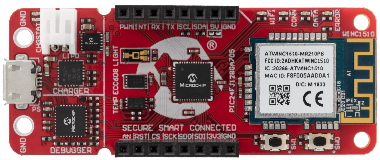
Microchip introduces new development board for Google Cloud IoT Core
Microchip Technology Inc. (Nasdaq: MCHP) announced a new Internet of Things (IoT) rapid development board for Google Cloud IoT Core that combines a low-power PIC® microcontroller (MCU), CryptoAuthentication™ secure element IC and fully certified Wi-Fi® network controller. The solution provides a simple way to connect and secure PIC MCU-based applications, removing the added time, cost and security vulnerabilities that come with large software frameworks and Real Time Operating Systems (RTOS). Once connected, Google Cloud IoT Core provides powerful data and analytics to help designers make better, smarter products.
source: Microchip Press Releases > Connect PIC® MCU Applications to Google Cloud in Minutes with Microchip’s New Development Board for Cloud IoT Core
Sunday, February 10, 2019
MicroPython introduce new Pyboard D Series Board with STM32F7xx
The upcoming Pyboard D-series (aka Pyboard D, or just PyBD) board was introduced during the FOSDEM 2019 Micropython presentation with a faster STM32F7 Cortex-M7 MCU, as well as built-in WiFi and Bluetooth connectivity.
(FOSDEM – stands for Free and Open Source Software Developers’ European Meeting)
know more:
- CNXSOFT – Pyboard D Series MicroPython Board Features STM32F7 MCU, WiFi and Bluetooth
(FOSDEM – stands for Free and Open Source Software Developers’ European Meeting)
know more:
- CNXSOFT – Pyboard D Series MicroPython Board Features STM32F7 MCU, WiFi and Bluetooth
Monday, January 21, 2019
Machine learning models + IoT data = a smarter world
With the IoT market set to triple in size by 2020, and massive increases in computing power on small devices, the intersection of IoT and machine learning is a trend that all developers should pay attention to. This talk will cover three core use cases, including: how to manage sourcing data from IoT devices to drive machine-learned models; how to deploy and use trained models on mobile devices; and how to do on-device training with a Raspberry Pi computer.
Machine learning models + IoT data = a smarter world (Google I/O '18)
Subscribe to:
Posts (Atom)


